
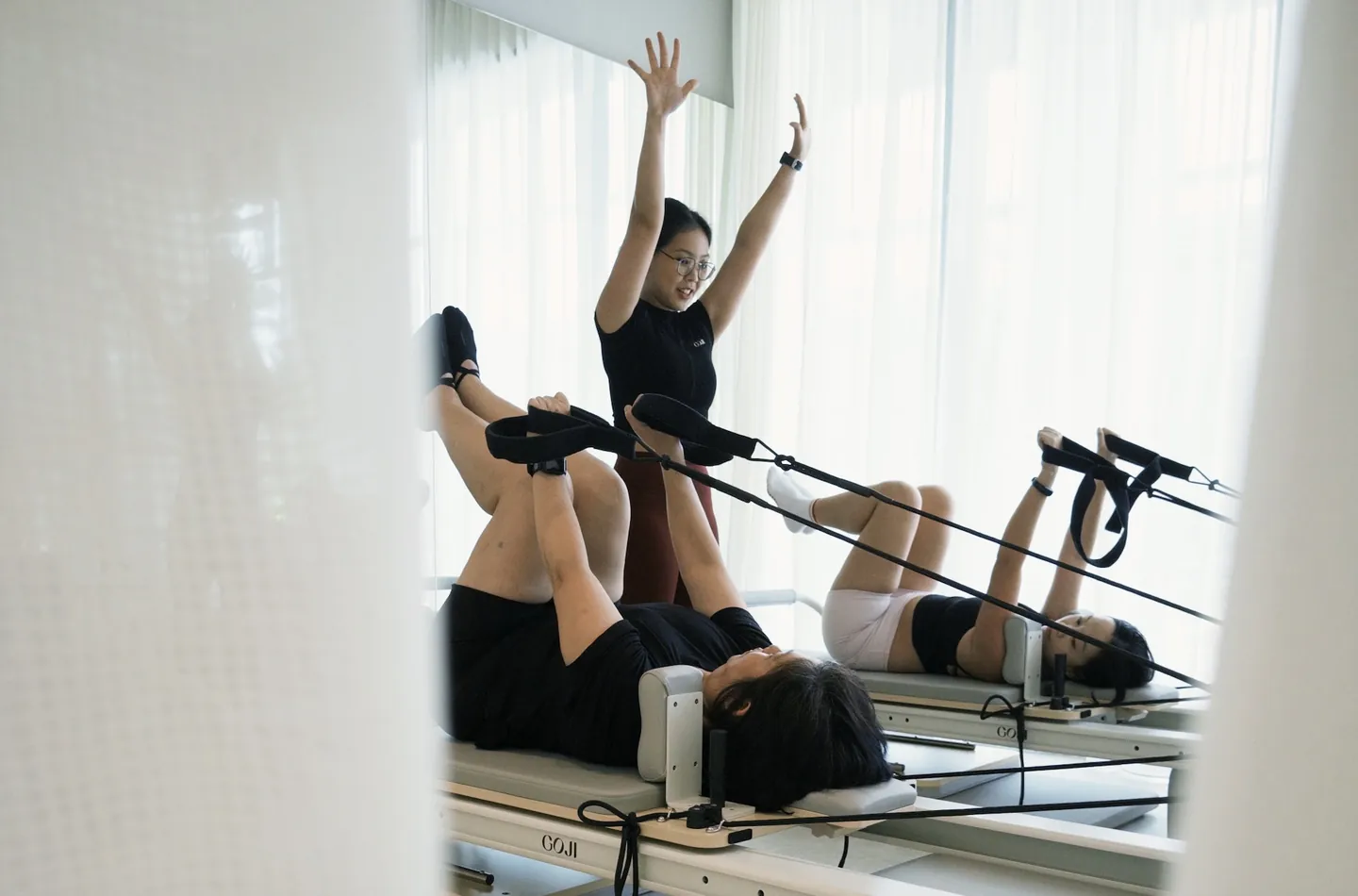
For most women, physiotherapy-led rehabilitation is the first step for diastasis recti, and surgery is not. Surgical repair is generally only considered when a separation is still causing functional problems after a period of structured training, or when there is a hernia alongside it. A Swedish surgical consensus, for example, suggests surgery only after a standardised 6-month core training programme, for a gap of at least 5 cm (smaller if there is marked bulging or a hernia), and at least 2 years after the last birth.
This post follows the first session of our “In Sync With…” series, which brought a physiotherapy view and a surgical view on diastasis recti together.
What was the In Sync With… session on diastasis recti?
“In Sync with Dr Pek - Decoding Diastasis Recti” was the first session in our “In Sync With…” series. It ran on Saturday 30 May 2026, from 2pm to 4pm, at Goji at Lentor Modern, for mothers who wanted to understand diastasis recti and postpartum recovery. 15 people attended.
The afternoon had four parts:
- Short individual diastasis assessments with the Goji physiotherapy team
- A physiotherapy talk on non-surgical rehabilitation, functional recovery, and how physiotherapy can help with lower back pain, pelvic dysfunction and core weakness
- A surgical perspective from Dr Pek Wan Sze, a plastic surgeon, on surgical options, including the criteria for surgical repair through abdominoplasty and related procedures
- Q&A and a social hour
The rest of this post is our own explainer, not a summary of what was said on the day.
What is diastasis recti, and how common is it?
Diastasis recti (also called diastasis recti abdominis, DRA, or rectus diastasis) is a widening of the linea alba, the band of connective tissue that joins the two sides of the rectus abdominis down the middle of the abdomen. During pregnancy the linea alba stretches and thins to make room for the baby. That is a normal adaptation, not an injury. You can read more on our diastasis recti condition page.
It is very common. A Norwegian study that followed 300 first-time mothers, using a palpated gap of two finger-widths or more as the definition, found diastasis in 33.1% of women at 21 weeks of pregnancy, 60.0% at 6 weeks after birth, 45.4% at 6 months and 32.6% at 12 months (Sperstad et al., 2016, British Journal of Sports Medicine). So the gap often narrows over the first year, but in about a third of women it was still there at 12 months.
The same study found no difference in reported lumbopelvic pain between women with and without diastasis. Gap size alone does not tell you whether it is causing a problem.
How is diastasis recti assessed?
The European Hernia Society defines rectus diastasis as a widening of the linea alba of more than 2 cm, and suggests measuring it by clinical examination, with ultrasound or callipers for more precise measurement (Hernández-Granados et al., 2021, British Journal of Surgery).
Width is only part of the picture. An ultrasound study found that when women with diastasis did a curl-up, the gap narrowed but the linea alba distorted, and that drawing in the deep abdominal muscle (transversus abdominis) first reduced that distortion (Lee and Hodges, 2016, JOSPT). The measure still needs validation, but it is one reason physiotherapists look at how the tissue behaves under load, not just its width.
At Goji, a diastasis assessment looks at:
- Inter-rectus distance, measured at several points along the linea alba using ultrasound or palpation
- Tissue tension, meaning whether the linea alba can generate tension under load, which is distinct from gap size
- Load testing, or how the abdominal wall behaves during tasks like getting up, lifting and coughing
- A pelvic floor screen, because diastasis and pelvic floor symptoms often occur together
What does physiotherapy for diastasis recti involve, and what does the evidence say?
Physiotherapy-led rehab usually means a progressive exercise programme for the abdominal wall and pelvic floor, built around daily tasks like lifting your baby or returning to exercise. It also addresses related problems that can sit alongside diastasis, such as lower back pain, pelvic girdle pain or bladder symptoms. The aim is a wall that can do its job, rather than a particular number on a tape measure.
The evidence is limited. A 2021 systematic review with meta-analysis of seven trials (381 women) concluded there is very low-quality evidence to recommend any specific exercise programme for treating diastasis after birth, and noted that most trials included women with mild diastasis (Gluppe, Engh and Bø, 2021, Brazilian Journal of Physical Therapy). The European Hernia Society guideline likewise says no specific non-operative treatment can be recommended, while suggesting physiotherapy may be considered before surgery.
That does not mean exercise does not help. It means research has not yet shown which programme is most effective, for whom, or by how much. That is why rehab is individualised and progressed according to how your body responds, and why it can help with function and symptoms even when the gap itself changes little.
If you are earlier on in recovery, our postpartum physiotherapy assessment covers diastasis alongside the rest of your recovery after birth.
When is surgery for diastasis recti considered?
Surgical repair is generally considered when diastasis is causing persistent functional problems after a period of conservative rehab, or when there is a hernia alongside it. Published guidance says:
- The Swedish consensus recommends physiotherapy as first-line treatment, and surgery only for women with functional impairment who have completed a standardised 6-month core training programme. It suggests a gap of at least 5 cm before surgery is considered, unless there is pronounced bulging or a hernia (Carlstedt et al., 2021, Scandinavian Journal of Surgery).
- The European Hernia Society guideline lists impaired body image and core instability as the most relevant symptoms. It suggests plication (stitching the linea alba together) where there is no hernia, a mesh-based repair where there is a midline hernia, and a choice of technique made through shared decision-making between patient and surgeon.
- Abdominoplasty (a tummy tuck) removes excess skin and fat and, in most cases, repairs separated or weakened muscles, according to the American Society of Plastic Surgeons. The society also says it is not a substitute for weight loss or an appropriate exercise programme.
Whether surgery is right for you is a decision for a surgeon, based on their own examination.
Physiotherapy or surgery: how do they compare?
| Physiotherapy-led rehab | Surgical repair | |
|---|---|---|
| Who it is generally for | Anyone with diastasis, at any stage after birth, as a first step | Women with persistent functional problems after structured rehab, or a hernia alongside the diastasis |
| What it involves | Assessment, then a progressive programme for the abdominal wall and pelvic floor, built around daily tasks | Plication of the linea alba, with mesh if there is a hernia, sometimes as part of an abdominoplasty |
| Timing | Can start weeks, months or years after birth | Swedish consensus suggests at least 2 years after the last birth, with no further pregnancy planned |
| Recovery considerations | No downtime; exercise is graded to how you respond | An operation, with recovery time, activity restrictions and surgical risks to discuss with your surgeon |
| Evidence | Very low-quality evidence for any specific programme | Most guideline recommendations are weak, based on low-quality evidence |
Frequently asked questions
Should I finish having children before considering surgery?
Published guidance points that way. The Swedish consensus suggests at least 2 years should pass after the last birth and that no further pregnancy should be planned, and the American Society of Plastic Surgeons suggests women who may be considering future pregnancies postpone a tummy tuck. Rehab, on the other hand, can be done between and during pregnancies.
Can I check for diastasis recti myself?
Roughly. Lie on your back, lift your head and feel along the midline. A gap wider than about two finger-widths at the belly button, with soft tissue that does not tense up, is worth having assessed. A self-check cannot show how the tissue behaves under load or whether there is a hernia, so it is a starting point, not a diagnosis.
Do I need a doctor’s referral to see a physiotherapist for diastasis recti?
No. You can book a women’s health appointment with us directly, without a doctor’s referral. Some insurers require a doctor’s referral letter to reimburse physiotherapy, so check your policy if you plan to claim.