
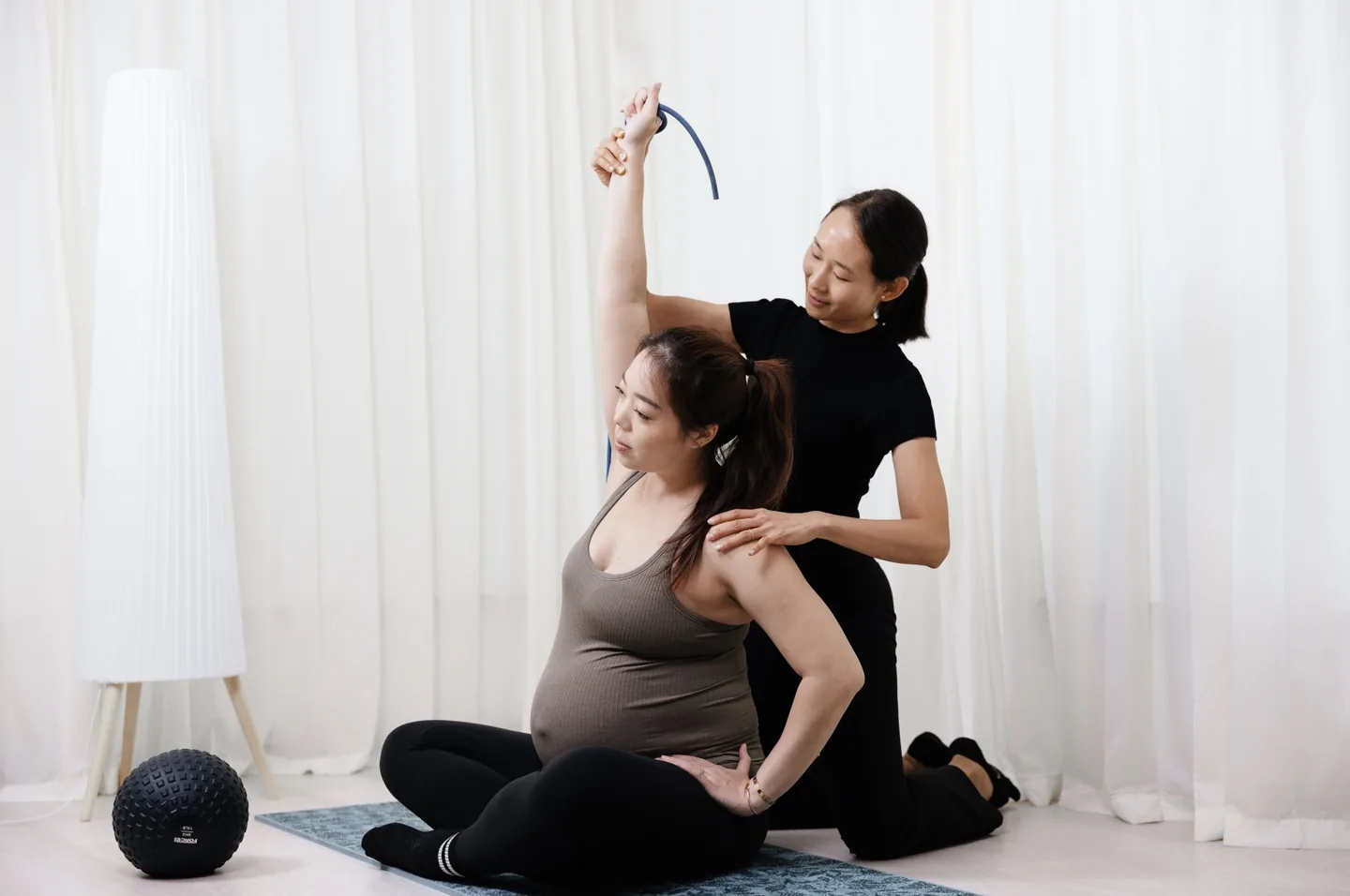
The most useful things you can do for your body in the months before pregnancy are to train your muscles at least twice a week, build up to around 150 minutes of moderate activity a week, and learn to use your pelvic floor well, which means relaxing it fully as well as squeezing it. These are the same habits the guidelines encourage during pregnancy, so the months before are a good time to make them routine.
This post is the physiotherapy side of pregnancy preparation. Questions about fertility, egg freezing or IVF belong with an obstetrician and gynaecologist.
What happened at “Your 30s, Your Options”?
On Saturday 19 September 2026, our Clinical Director Cheryl Long joined Dr Serena Koh, Consultant Obstetrician & Gynaecologist at The O&G Specialist Clinic, for In Sync with Dr Serena - Your 30s, Your Options. The afternoon was hosted at The O&G Specialist Clinic in Novena Medical Center, for women in their late 20s to mid-30s curious about fertility, with partners welcome.
The programme paired two perspectives. Dr Serena covered the medical side: fertility checks, ovarian reserve, egg freezing, IVF, natural conception, contraception and when to seek medical support in Singapore. Cheryl covered the physiotherapy side: pelvic health, strength training, core and pelvic floor function, pregnancy preparation and postpartum recovery. A Q&A and social hour followed, and 31 people attended.
What follows is our own explainer on the physiotherapy topics, not a summary of the talk.
Why does strength matter before pregnancy?
Pregnancy asks a lot of your muscles and joints. Your weight and centre of gravity change, and then you spend months lifting and carrying a baby. A stronger base makes those demands easier to meet.
There is also a practical reason to start now. The WHO 2020 guidelines on physical activity and ACOG Committee Opinion No. 804 both say that women who were physically active before pregnancy, including those who did vigorous activity, can generally continue during pregnancy and after birth, provided there are no medical or obstetric reasons not to. The routine you build now is one you can usually adapt and keep, rather than having to start from scratch while pregnant.
For adults generally, WHO recommends:
- 150-300 minutes of moderate activity a week, or 75-150 minutes of vigorous activity, or a mix of the two
- Muscle-strengthening activity at moderate or greater intensity, working all the major muscle groups, on 2 or more days a week
For pregnancy and the postpartum period, WHO recommends at least 150 minutes of moderate activity a week, a variety of aerobic and muscle-strengthening activities, and less time spent sitting.
What does a pelvic floor actually need to do?
Your pelvic floor is a group of muscles that supports your bladder, bowel and uterus and helps you stay continent. A well-functioning pelvic floor can contract when it needs to, such as when you cough, sneeze or lift, and it can also relax fully, which you need for emptying your bladder and bowel comfortably, for comfortable sex, and later for birth.
Some people hold tension in their pelvic floor without realising it. More squeezing is not the answer for them, and learning to let go is part of the work. The NICE guideline on pelvic floor dysfunction (NG210) reflects this: when a programme is supervised, it says the first step is assessing a woman’s ability to both contract and relax her pelvic floor.
Should I start pelvic floor exercises before I am pregnant?
NICE NG210 encourages women of all ages to do pelvic floor muscle training to help prevent symptoms, and to keep it up throughout life. It also encourages training during pregnancy and after birth.
The evidence for training in pregnancy is reasonably good. A 2020 Cochrane review found that continent pregnant women who did pelvic floor training were probably 62% less likely to report urinary leakage in late pregnancy than women having usual care (moderate-quality evidence). Learning the technique before you are pregnant means you are not trying to learn it for the first time alongside everything else.
If you are not sure you are doing it correctly, or you have leaking, heaviness or pain with sex now, a pelvic floor assessment is a sensible first step. NICE recommends that supervised programmes are run by a physiotherapist or other professional with the right expertise.
What can I do in the months before pregnancy?
| Step | What it looks like | Why |
|---|---|---|
| Strength train twice a week | Squats, lunges, deadlift or hip-hinge patterns, rows, presses, carrying. Use weights, bands or bodyweight, and work all major muscle groups. | WHO recommends it on 2 or more days a week, and it builds capacity for pregnancy and lifting a baby. |
| Build up your aerobic activity | Brisk walking, cycling, swimming, dance, running if you already run. Aim for 150 minutes of moderate activity a week. | Matches WHO guidance for adults and for pregnancy. |
| Learn a full pelvic floor contraction | Gently draw up and lift, as if stopping wind and the flow of urine, without holding your breath or clenching your buttocks. | NICE encourages training at all ages to help prevent symptoms. |
| Learn to relax it too | After each contraction, let the muscles fully let go. Practise breathing into your belly and feeling the pelvic floor drop. | Relaxation matters for emptying, comfortable sex and birth. |
| Sit less | Break up long stretches at a desk with a short walk or a few stairs. | WHO recommends limiting sedentary time, including in pregnancy. |
| Deal with niggles now | Back, hip or pelvic pain, leaking or heaviness are worth assessing before pregnancy adds load. | Easier to work on before your body starts changing. |
| Talk to your doctor | Pre-pregnancy health checks, medications, and supplements such as folic acid. | WHO recommends 400 micrograms of folic acid daily from when you start trying until 12 weeks of pregnancy. Your doctor can advise on your dose. |
Is there anything I should be careful with?
Most healthy women can train hard before pregnancy. A few points are worth keeping in mind:
- Progress gradually if you are new to lifting. Good technique and steady progression matter more than the weight on the bar.
- Notice how your pelvic floor responds. Leaking, heaviness or a dragging feeling during running, jumping or heavy lifts is a signal to get assessed, not something to push through.
- Breathe through effort. Holding your breath on every lift raises the pressure inside your abdomen. Exhaling as you lift is a good default while you learn.
- If you have a medical condition, a history of pregnancy complications, or you are going through fertility treatment, check with your doctor about what activity is right for you.
Some aches, like pelvic girdle pain, are common in pregnancy. Our prenatal care page covers what physiotherapy can help with once you are pregnant.
Frequently asked questions
Can I keep lifting weights once I am pregnant?
For most women with an uncomplicated pregnancy, yes. WHO and ACOG both say women who were active before pregnancy can generally continue, with changes as the pregnancy progresses. Check with your obstetrician, and expect to adjust load, positions and intensity over time.
Does physiotherapy help me get pregnant?
There is no good evidence that physiotherapy improves fertility, and we do not claim it does. What physiotherapy can help with is preparing your body for the physical demands of pregnancy and recovery. For fertility questions, see an obstetrician and gynaecologist.
How do I know if I am doing pelvic floor exercises correctly?
It is hard to tell on your own. Common mistakes are bearing down instead of lifting, holding your breath and squeezing your buttocks or thighs. A physiotherapist can check your technique, including whether you can relax fully, and adjust your programme. Our prenatal physiotherapy assessment includes a pelvic floor assessment where relevant, and an internal examination is always optional.
How long before trying to conceive should I start?
There is no set timeline. Any time you start is useful. Strength usually builds over weeks to months, so a few months of regular training before you start trying gives you a solid base to carry into pregnancy.