
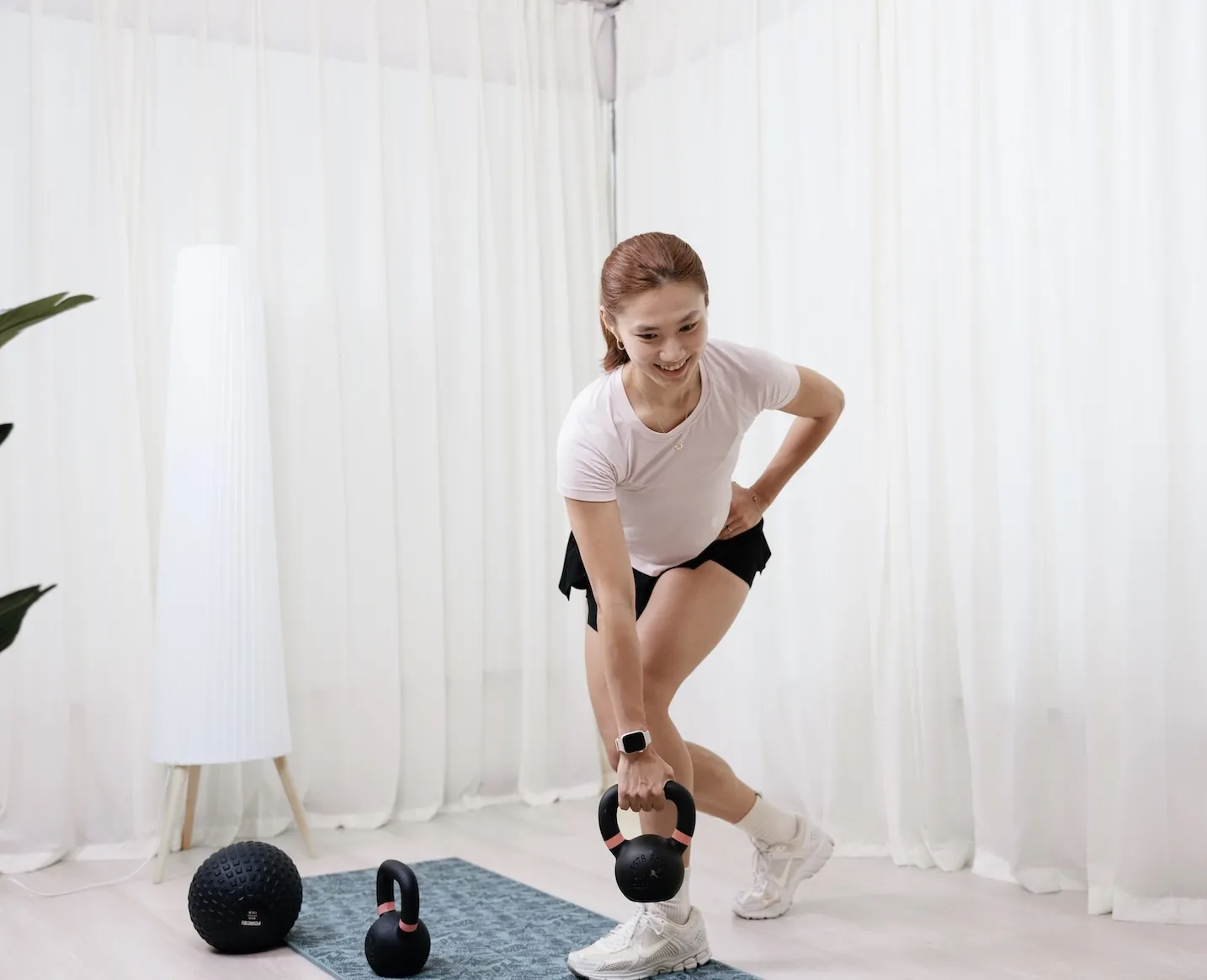
The six-week check is a medical clearance, not a starting gun. It tells you that healing is on track. It does not tell you that your pelvic floor and abdominal wall are ready for running, jumping or heavy lifting, because it does not test them under load. Build strength first, and bring impact back when your body passes those tests rather than on a set date.
What follows is an illustration of how a straightforward return can unfold. Every birth and every body is different, and a physiotherapist sets the actual pace with you.
What does each stage usually involve?
| Stage | Main focus | Usually not yet |
|---|---|---|
| Weeks 0 to 6 | Breathing with the pelvic floor, gentle activation, building up walking, comfortable feeding and lifting positions | Running, jumping, heavy lifting, crunches |
| Around week 6 | Medical check with your doctor; a pelvic health and abdominal assessment under load | Assuming the medical check means “ready for anything” |
| Weeks 6 to 12 | Progressive strength training, loaded carries, single-leg work, Pilates | High-impact work before the load tests feel easy |
| After that | Impact and running added gradually, often walk-run first | Jumping straight back to your old volume |
Weeks 0 to 6: less than you think, on purpose
The work in this window is unglamorous: breathing that coordinates with the pelvic floor, gentle activation, walking that builds gradually, and getting positions for feeding and lifting sorted so you are not spending all day loaded badly.
Two things people underestimate here. Walking counts, and it progresses faster than expected if you build it steadily. And sleep and feeding load matter to recovery as much as any exercise does.
Around week 6: get assessed, then decide
This is a useful point for a postpartum physiotherapy assessment. It looks at the pelvic floor’s ability to contract and relax, the abdominal wall including any separation, how your breathing and pressure management work, and how all of that behaves when load goes up.
The assessment is what makes the timeline specific to you. Someone with good pelvic floor control and no symptoms progresses differently from someone with a heaviness sensation or a persistent gap, and it is not possible to tell which you are without looking.
Weeks 6 to 12: build capacity before impact
The general shape here is strength work first, impact later. Progressive resistance training, loaded carries, single-leg work, and gradually heavier compound movements build the capacity that running demands.
The 2019 UK return-to-running guideline (Goom, Donnelly and Brockwell) set out simple load and impact tests, such as single-leg balance, single-leg squats, jogging on the spot and hopping, to pass without symptoms before running. A 2024 international consensus of clinicians and coaches went further on individualising it: a gradual walk-run return, strength training alongside, and adjusting for pelvic symptoms, sleep, mental health and feeding (Deering et al., 2024). In both, readiness matters more than the date.
Reformer Pilates and structured strength sessions both fit well in this window, which is why we run Clinical Pilates alongside physiotherapy.
What are the signs to slow down?
Whichever week you are in, these are reasons to pull back and get reviewed:
- Leaking that appears or worsens with an activity
- A heaviness, dragging or bulging sensation in the vagina
- Pelvic or low back pain that builds through a session or the day after
- Doming or coning along the midline of the abdomen during effort
- Bleeding that increases after you have been progressing
None of these mean something has gone wrong permanently. They mean the load is currently ahead of the capacity, and the answer is usually to adjust rather than to stop everything.
Frequently asked questions
When can I start running again?
There is no single safe date. Earlier UK guidance suggested around twelve weeks at the earliest; more recent consensus puts the emphasis on readiness, meaning you can do the load and impact tests without leaking, heaviness or pain, then build up with walk-run intervals. An assessment is how you establish readiness.
Is it too late to start if my baby is already one?
No. There is no window that closes. Rebuilding strength and pelvic floor function is worth doing whenever you get to it.
Does a caesarean birth change the timeline?
It changes the early weeks, since there is abdominal wound healing to respect, but pregnancy has loaded the pelvic floor regardless of delivery route. Assessment is just as relevant. Our caesarean recovery page covers the early weeks.
Can I exercise while breastfeeding?
Yes. Feed or express beforehand if comfort is an issue, and keep fluid intake up. Breastfeeding is not a reason to avoid strength training.
What about diastasis recti?
Abdominal separation is common: in one study of 300 first-time mothers, about 60% had it at six weeks after birth and about a third still did at twelve months (Sperstad et al., 2016). How well you can generate tension across the gap matters more than its width, which is what an assessment looks at. Our diastasis recti page covers this in more detail.