
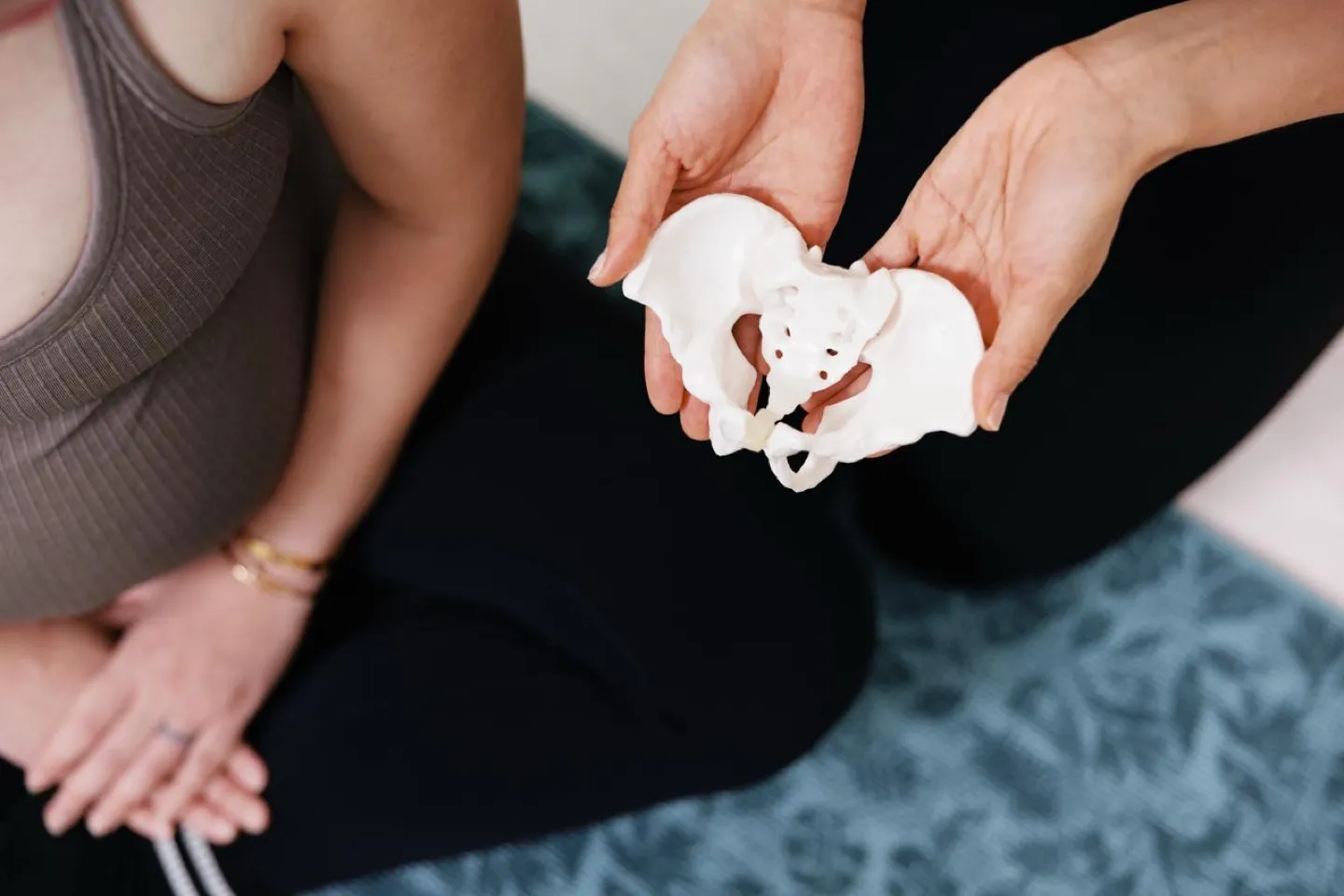
Short answer: it is common. Across 24 studies of more than 35,000 women, about 31% had some urinary leaking between six weeks and one year after birth (Moossdorff-Steinhauser et al., 2021). Some of it settles by itself as the pelvic floor recovers. Leaking that is still there at three months, or that is changing what you are willing to do, is worth getting assessed.
“That’s just what happens after babies” is still a very common thing for women to be told. The guidelines say otherwise: supervised pelvic floor muscle training is the recommended first treatment for stress and mixed urinary incontinence (NICE).
Why does it happen in the first place?
Pregnancy and birth load the pelvic floor heavily. The muscles that help keep the urethra closed have been stretched, sometimes injured, and are working alongside abdominal muscles that have also changed shape. When you sneeze, cough, laugh, run or lift, pressure inside the abdomen rises sharply. If the pelvic floor cannot respond fast enough or firmly enough at that moment, some urine escapes.
That is stress urinary incontinence, the most common type after birth: just over half of postpartum leaking in the same review was stress-type. It is a timing and load problem as much as a strength problem, which is part of why simply doing more squeezes does not always fix it.
Stress leaking or urgency leaking: which is it?
The type of leaking changes what helps, so it is the first thing an assessment pins down.
| Stress leaking | Urgency leaking | |
|---|---|---|
| When it happens | With a cough, sneeze, laugh, jump, run or lift | With a sudden, strong need to go, often with little warning |
| Typical triggers | Pressure rising in the abdomen | Key in the door, running water, cold, a full-ish bladder |
| What it usually points to | The pelvic floor not closing firmly or quickly enough under load | An overactive bladder signal, sometimes alongside pelvic floor changes |
| First-line approach | Pelvic floor muscle training, timed to the activity | Bladder training and habit changes, with pelvic floor work where relevant |
Some people have both, which is called mixed incontinence.
What usually settles on its own?
In the first six to eight weeks, some improvement is expected. Tissue is healing, swelling is going down, and the muscles are gradually returning to a normal resting state. Waiting and watching during that window is reasonable.
What tends not to resolve by waiting:
- Leaking that is unchanged between six weeks and three months
- Leaking that only shows up when you go back to running or lifting
- A sense of heaviness or dragging in the vagina alongside the leaking
- Leaking together with urgency, where you get very little warning
Are pelvic floor exercises enough on their own?
Sometimes, but not reliably, and not without knowing what you are working with first.
Not everyone who leaks has a weak pelvic floor. Some people have an overactive one that never fully relaxes, and in that case a programme of hard squeezing can make symptoms worse. Others are contracting the wrong muscles altogether, holding their breath, or bearing down when they think they are lifting.
That is why NICE specifies supervised training for at least three months, with progress reviewed, rather than a leaflet of exercises. An assessment establishes what your pelvic floor is actually doing before anyone prescribes exercises for it.
What happens at an assessment?
A first appointment is mostly conversation and observation. We take a bladder history: what you drink, how often you go, when the leaking happens and what sets it off. That alone usually distinguishes stress leaking from urgency leaking.
The physical part looks at how the pelvic floor contracts, whether it can relax again, how long it holds, and how it copes under load, so coughing, jumping or lifting depending on what is relevant to you. An internal vaginal assessment gives the clearest information and is offered, but it is not required, and plenty of useful assessment happens without it.
Our urinary incontinence page goes into the different types in more detail, and what happens at your first physiotherapy visit walks through the appointment itself.
Frequently asked questions
How long after birth should I wait before getting assessed?
If leaking is your only concern and it is improving, six to eight weeks is a reasonable point to review. If it is not improving, or if there is pain, heaviness or a feeling of something bulging, there is no reason to wait. Assessment is appropriate at any stage after birth.
Is it too late if I gave birth years ago?
No. Pelvic floor muscle training is recommended as a first treatment regardless of how long symptoms have been present, and it is worth doing at any age.
Does it only affect women who had a vaginal birth?
No. Pregnancy itself loads the pelvic floor, so leaking occurs after caesarean birth too. The delivery route changes some of the picture but does not decide whether symptoms appear.
Can I keep running while I sort this out?
Usually yes, often with adjustments to distance, surface or timing while you build capacity. Stopping all loading is rarely the answer. Part of the assessment is working out what you can keep doing safely.