
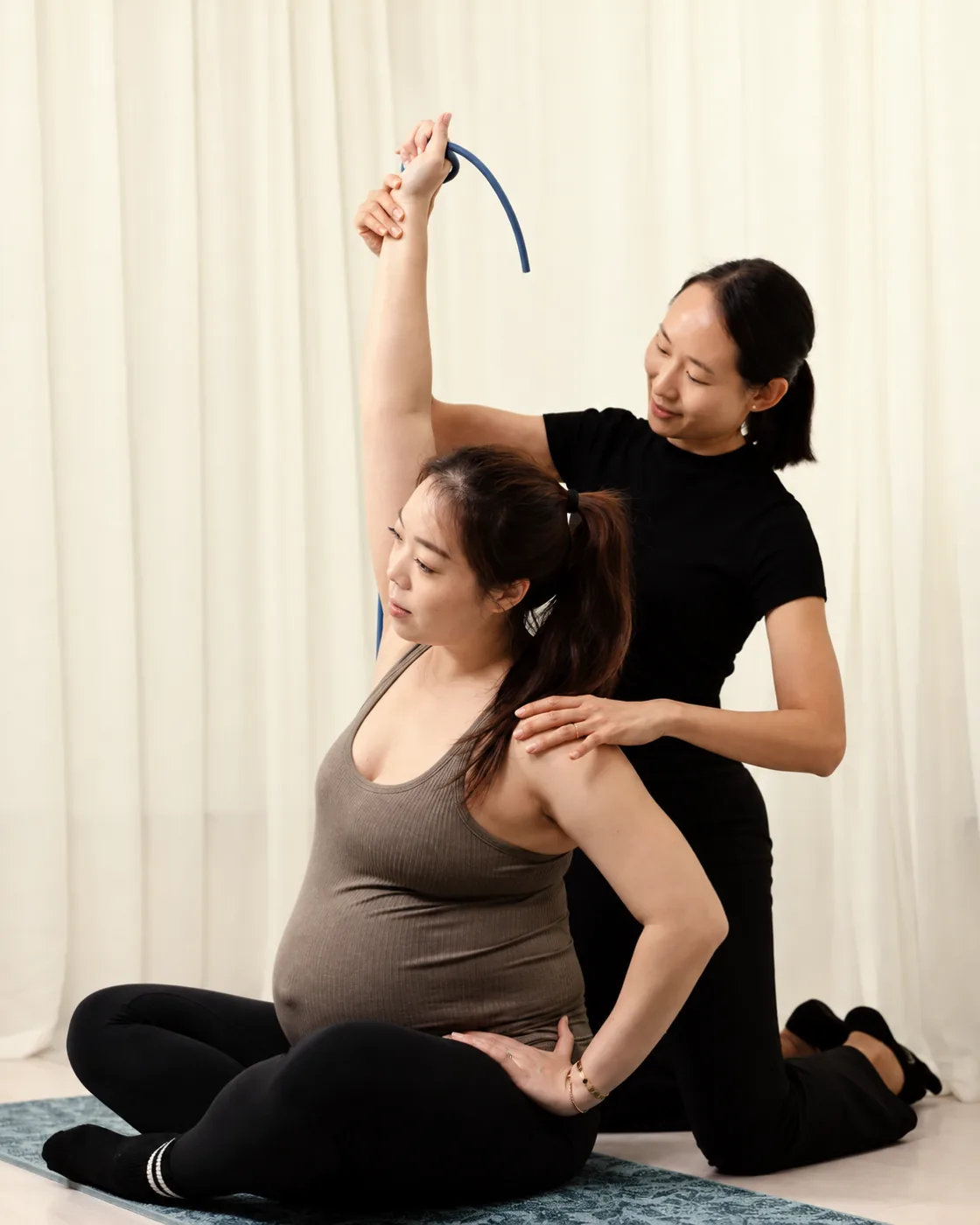
Start from 34 or 35 weeks of pregnancy and carry on until your baby arrives (RCOG; Cambridge University Hospitals). A few minutes at a time is enough, and once or twice a week appears to help about as much as doing it more often. The benefit is real but modest, and it shows up mainly in women having their first vaginal birth.
What does perineal massage actually do?
The perineum is the skin and muscle between the vaginal opening and the anus. It has to stretch a long way as your baby’s head is born. Massaging it in the last weeks of pregnancy gets the tissue used to stretching, and gets you used to the feeling of it.
It won’t stop tears altogether. Up to 9 in 10 first-time mothers who have a vaginal birth have some sort of tear, graze or episiotomy (NHS), and most of these heal well. What the massage does is shift the odds a little in your favour.
What did the Cochrane review find?
The main summary of the evidence is a Cochrane review of four trials with 2,497 women, who did perineal massage with their fingers in roughly the last month of pregnancy (Beckmann and Stock, 2013). Women who did the massage were less likely to have a tear or cut that needed stitches: for every 15 women who did it, one fewer needed stitches. Most of that came from fewer episiotomies, the cut a doctor sometimes makes to widen the opening. There, for every 21 women who did the massage, one fewer had an episiotomy.
The results depend on your history, and in particular on any previous vaginal birth.
| Outcome in the review | First vaginal birth | Had a vaginal birth before |
|---|---|---|
| Tear or cut that needs stitches | Less likely | No clear difference |
| Episiotomy | Less likely | No clear difference |
| Third- or fourth-degree tear (into the anal sphincter) | No difference found | No difference found |
| Perineal pain three months after birth | No clear difference | Less likely, in one trial of 376 women |
Source: Beckmann and Stock, Cochrane Database of Systematic Reviews, 2013.
So if this is your first vaginal birth, massage can help lower your chance of needing stitches. If you’ve given birth vaginally before, it didn’t change the chance of stitches, but in that one trial women who did it were less than half as likely to report perineal pain three months later. The review didn’t find a difference in the deeper tears. For context, the RCOG puts the risk of one of those at about 6 in 100 for a first birth and 2 in 100 for women who’ve had a vaginal birth before (RCOG).
When should you start, and how often?
UK hospital leaflets say to start any time from 34 weeks (Cambridge University Hospitals; Leeds Teaching Hospitals). The RCOG says from 35 weeks. The trials in the Cochrane review covered roughly the last month of pregnancy, so the research doesn’t tell us anything about starting earlier than that.
How often is where advice varies. Cambridge suggests three to four times a week for three to five minutes, and Leeds suggests three to four times a week for five to ten minutes. Both add that once or twice a week may still be of benefit.
That fits the review. When the authors split women by how often they massaged, more wasn’t better. Women who averaged up to about one and a half sessions a week had a 16% drop in tears needing stitches. Those doing 1.5 to 3.4 sessions had an 8% drop, and above 3.5 sessions a week there was no clear difference (AAFP summary of the Cochrane review). If a daily routine feels like a chore in the last weeks, twice a week is a perfectly reasonable target.
How do you do perineal massage, step by step?
This follows the Cambridge and Leeds leaflets.
- Empty your bladder and wash your hands. Short nails make it more comfortable.
- Get into a position you can relax in. Semi-sitting propped on pillows works for most people, or squat against a wall, or stand with one foot up on the edge of the bath. A warm bath or shower first can help soften the tissue.
- Put a little lubricant on your thumbs. Unscented olive or sunflower oil, sweet almond oil (not if you have a nut allergy) or a water-based gel are all fine. Leave out baby oil, mineral oil and petroleum jelly.
- Slide your thumbs about 5 cm into the vagina, roughly up to the second knuckle.
- Press gently but firmly down towards the anus until you feel a stretch. Breathe slowly and let your pelvic floor soften.
- Keeping that pressure, sweep your thumbs slowly in a U shape, up one side, round the bottom and up the other side, then back again.
- You can finish by gently massaging the skin of the perineum between your thumb and forefinger.
A hand mirror helps for the first few goes. It can tingle or feel uncomfortable, but it shouldn’t hurt. If it does, stop and try again another day.
Can your partner do it?
Yes, if you both want to, and it’s completely up to you (Leeds Teaching Hospitals). Your partner uses the same technique with both index fingers instead of thumbs. Keep talking while they do it, and tell them straight away if it burns or hurts (Cambridge University Hospitals).
When shouldn’t you do it?
Don’t do perineal massage if you think your waters may have broken, or if you have thrush, herpes or another vaginal infection. Contact your hospital or midwife instead (Cambridge University Hospitals; Leeds Teaching Hospitals).
If your pregnancy is being watched more closely, for example for a low-lying placenta, a stitch in your cervix or a risk of early labour, ask your obstetrician before you start. Those are the same situations where we check with your obstetric team before treating you (prenatal care).
It’s also optional. If it feels distressing for any reason, you can leave it out. Plenty happens in labour itself to protect the perineum, such as your midwife asking you to stop pushing and take short breaths as the head comes out, so it can stretch slowly (NHS).
Where does a physio come in?
At Goji, prenatal physiotherapy can include birth preparation and perineal massage instruction from 34 weeks, alongside pelvic floor preparation, labour positions and breathing. You’re welcome to bring your birth partner. An internal examination is offered when it’s relevant and is always optional.
If you do tear during birth, our page on perineal tears and scars covers what recovery usually looks like and when to get help, and pelvic floor exercises after birth explains how to start again gently.
Frequently asked questions
Can I use a perineal massage tool instead of my fingers?
The trials in the Cochrane review used fingers, so that’s what the evidence covers. We don’t know whether massage tools give the same result. If you’d like to use one, check with your midwife or obstetrician first.
Is it worth doing if I’m planning a vaginal birth after a caesarean?
It can be. If you haven’t given birth vaginally before, you’re in the group that showed a benefit in the review, and Cambridge University Hospitals lists women planning a vaginal birth after caesarean among those who may benefit (Cambridge University Hospitals). The trials were about vaginal birth, so if you’re planning another caesarean, ask your obstetrician whether it’s worth doing.
What if I only remember at 37 or 38 weeks?
You can still start. You’ll fit in fewer sessions than the women in the trials did, and the trials didn’t look at a late start separately, but the same rules apply: stop if it hurts, and don’t do it once your waters may have broken.
Is it safe for the baby?
Cambridge University Hospitals says there are no known risks apart from the situations listed above, which are an infection or waters that may have broken (Cambridge University Hospitals).