
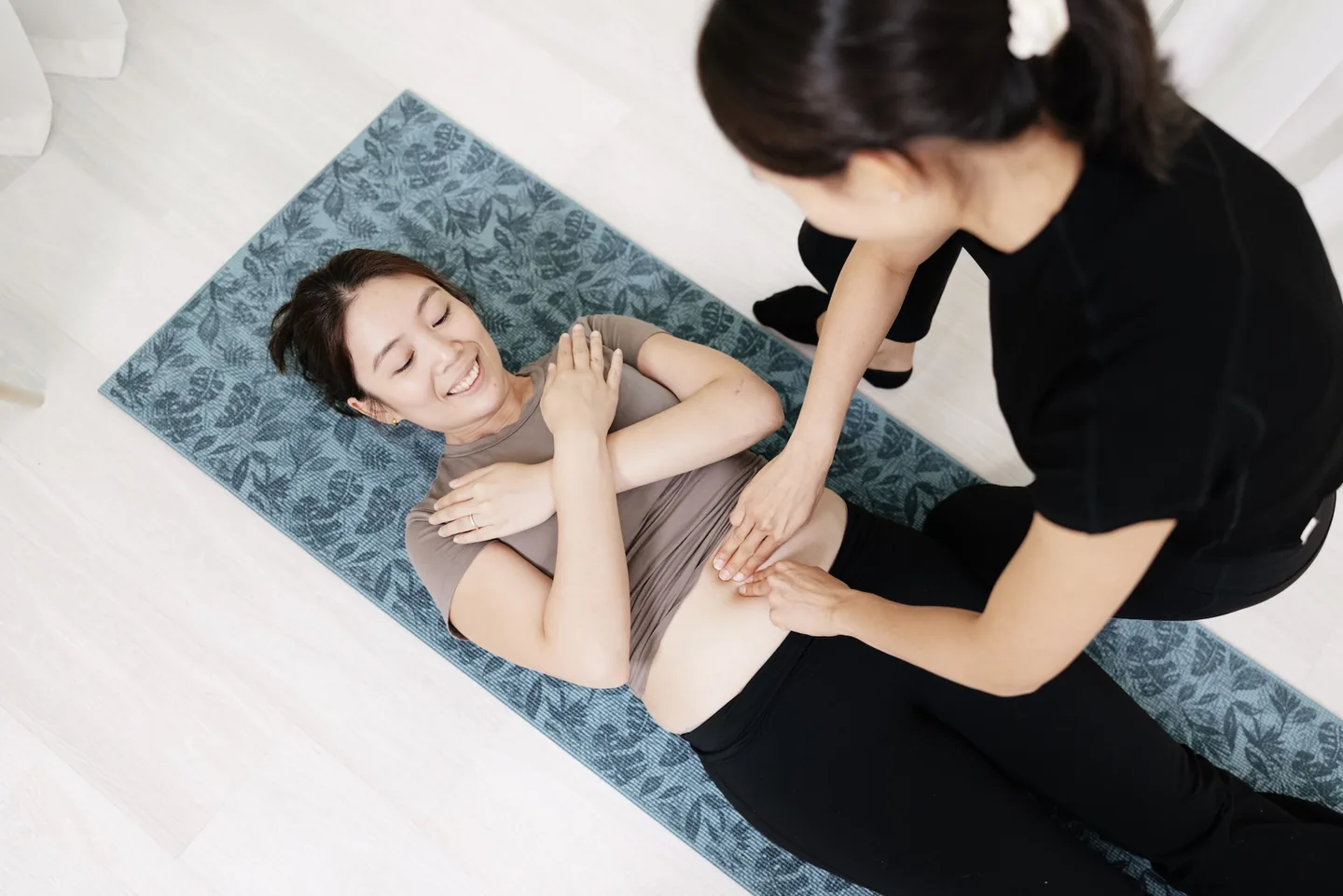
You can usually start gentle pelvic floor exercises in the first few days after birth, as long as they feel comfortable. NHS guidance says that after a straightforward birth you can begin gentle exercise, including pelvic floor exercises, “as soon as you feel up to it” (NHS), and NICE recommends that women are encouraged to do pelvic floor muscle training before they leave maternity care and during routine postnatal care (NICE NG210, 1.3.13). Start with a few gentle squeezes lying down, build up slowly, and get assessed if something does not feel right.
When can I start pelvic floor exercises after birth?
After a vaginal birth, a hospital patient leaflet from King’s College Hospital in London says the exercises can be started within the first days after delivery, beginning gently with squeezes held for a few seconds (King’s College Hospital). It is normal to feel very little at first.
After a caesarean, your pelvic floor has still carried the load of pregnancy, so the exercises are still relevant. If you still have a urinary catheter in, ask your ward team before you start. Our page on Caesarean recovery covers the rest of that recovery.
NICE suggests considering a 3-month supervised programme for women whose birth involved forceps or vacuum, a baby lying face up (occipito-posterior), or an injury to the anal sphincter (NICE NG210, 1.3.12). If any of those apply to you, it is worth asking about supervised training rather than relying on a leaflet alone.
How do I do pelvic floor exercises after birth?
-
Find the right muscles. Imagine stopping yourself passing wind and stopping a flow of urine at the same time, then squeeze and lift inwards and upwards. Do the exercises after you have emptied your bladder, not by stopping your urine mid-flow (NHS).
-
Start lying down. Lying on your back with knees bent, or on your side, takes gravity out of the picture and is usually the easiest position to feel the squeeze in the early days.
-
Practise slow holds. Squeeze and lift, hold for a few seconds, then let go and rest for a few seconds. Over time, work towards holding for up to 10 seconds, but no longer (NHS).
-
Add quick squeezes. Squeeze firmly, then let go straight away. These train the muscles to react quickly, for example when you sneeze.
-
Relax fully between each one. Letting go matters as much as squeezing. A pelvic floor that never fully relaxes can cause its own problems, which is why NICE says supervised training should assess both contraction and relaxation (NICE NG210, 1.3.16).
-
Learn “the knack”. Squeeze your pelvic floor just before and during a cough, sneeze or lift. In a small study of older women with mild to moderate stress incontinence, this timed squeeze reduced the amount of urine lost during a cough (Miller et al. 1998).
-
Progress your position, then build it into daily life. Once squeezes feel easy lying down, try them sitting, then standing, then while lifting your baby or getting up from a chair. NICE encourages women to keep up pelvic floor training throughout life, not just after birth (NICE NG210, 1.3.10).
What is a good starting routine?
The table below is a starting point, not a prescription. The right amount depends on how your birth went and what your pelvic floor is doing, and a pelvic health physiotherapist can adjust it for you.
| Stage | Position | Slow holds | Quick squeezes | How often | Source |
|---|---|---|---|---|---|
| First days, if comfortable | Lying on your back or side | Hold a few seconds, rest a few seconds | A few, gently | Little and often | King’s College Hospital |
| As it gets easier | Lying, then sitting | Build up to 10 seconds, 10 times | Build up to 10 | At least 3 times a day | NHS |
| If you have stress leaking | Sitting and standing | At least 8 contractions per session | Included in your plan | 3 times a day, for at least 3 months | NICE NG123, 1.4.4-1.4.5 |
| Longer term | Standing and during daily tasks | Keep a regular routine | Use the knack before effort | Most days, ongoing | NICE NG210, 1.3.10 |
The NICE figure in the third row comes from its guideline on urinary incontinence, where a supervised programme of at least 3 months is the first-line treatment for stress or mixed leaking.
What are the most common mistakes?
- Holding your breath. You should be able to breathe normally, and even hold a conversation, while you squeeze (King’s College Hospital).
- Squeezing your buttocks or thighs, or pressing your legs together. These muscles can take over without the pelvic floor doing much.
- Pulling your stomach in hard. The NHS advises not pulling in your stomach as you squeeze (NHS).
- Bearing down instead of lifting. Pushing down is the opposite of what you want. In one study, only 49% of women did an ideal contraction after brief verbal instructions, and 25% used a technique that could make leaking worse (Bump et al. 1991).
- Never letting go. Squeezing all day, or never fully relaxing between holds, is not the goal.
Do pelvic floor exercises after birth actually work?
The evidence is clearer for prevention than for treatment. A 2020 Cochrane review of 46 trials found that structured pelvic floor training during pregnancy, in women who were not leaking, probably lowers the chance of leaking in late pregnancy and slightly lowers it 3-6 months after birth. For women who are already leaking after birth, the effect of training was uncertain, and the programmes studied varied a lot (Woodley et al. 2020).
That does not mean the exercises are pointless after birth. NICE still recommends encouraging pelvic floor training after birth, and recommends that training is supervised by a physiotherapist or other professional with the right expertise, who checks your technique and adjusts the programme (NICE NG210, 1.3.13-1.3.16). Getting the technique right is a large part of the answer.
When should I get assessed instead of managing it myself?
An assessment can help if:
- You cannot feel anything happening, or are not sure you are doing it right, after a few weeks of practice.
- You are still leaking urine around 3 months after birth. Our post on whether leaking after birth is normal covers this in more detail, and so does our urinary incontinence page.
- You notice heaviness, dragging or a bulge in the vagina, which can be a sign of pelvic organ prolapse.
- You leak wind or stool, or find it hard to control your bowels. The NHS advises telling your midwife or GP about this (NHS).
- The exercises hurt, or you have pain with sex, ongoing perineal pain or pelvic pain.
- You find it hard to empty your bladder or bowels, or the pelvic floor feels tight. Some people have an overactive pelvic floor that needs to learn to relax, and strengthening alone may not help.
- You want to return to running or high-impact exercise. See our post on returning to exercise after birth.
At Goji, a pelvic floor physiotherapy assessment looks at whether your pelvic floor needs strengthening, relaxation or better coordination. An internal examination is always optional, and you do not need a doctor’s referral. If you want your whole recovery looked at, postpartum physiotherapy covers your pelvic floor alongside your tummy, scar and return to exercise.
Frequently asked questions
Can I do pelvic floor exercises if I have stitches?
Gentle squeezes are generally part of early postnatal advice after a tear or episiotomy, but start softly and stop if it hurts. If your stitches are very sore or the pain is getting worse rather than better, tell your midwife or doctor, as NICE lists worsening perineal pain as something to check (NICE NG194, 1.2.15).
Should I practise by stopping my urine mid-flow?
No. It can be a one-off way to identify the muscles, but it is not an exercise. The NHS suggests using the toilet as a reminder, then doing the exercises after you have finished (NHS).
How long until I notice a difference?
It varies from person to person. NICE’s guideline on urinary incontinence recommends a supervised programme of at least 3 months before judging whether it is working (NICE NG123, 1.4.4), so a few weeks without change is not a reason to give up.