
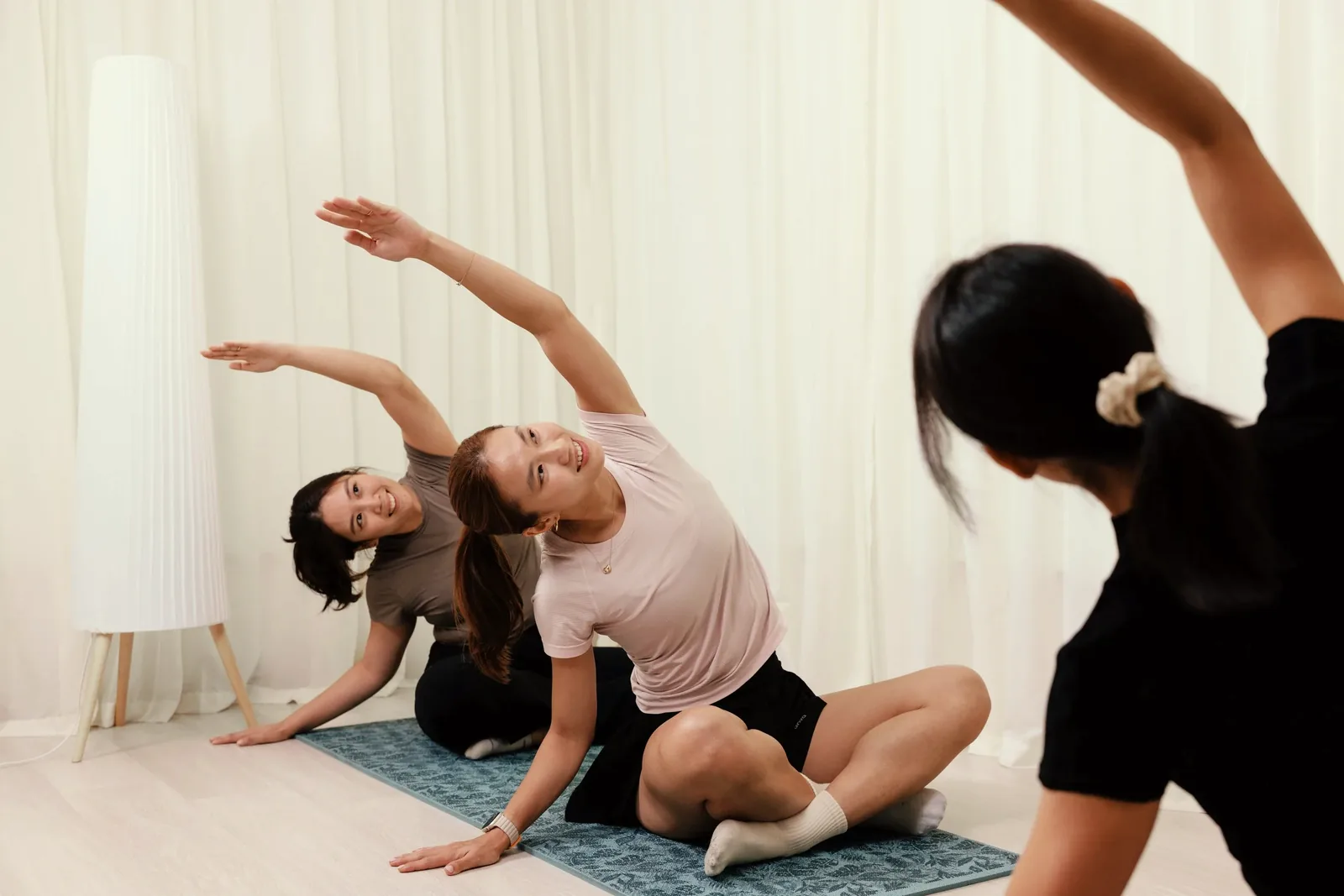
Pretty much anywhere you’d have trained before, plus a few options built around mums. In Singapore that means a gym or personal trainer, a Pilates studio (mat, reformer or clinical), mum-and-baby classes, free community workouts, and walking or jogging the park connectors. The venue matters less than the person coaching you. Look for someone who asks how your pelvic floor and tummy are doing before they add running, jumping or heavy lifting.
For the week-by-week picture of what to add and when, read returning to exercise after birth. This post is about where to go and who to train with.
How much exercise is recommended after giving birth?
Singapore’s physical activity guidelines for pregnant and postpartum women suggest at least 150 minutes of moderate activity a week, plus some muscle-strengthening work (Singapore Physical Activity Guidelines, HPB and Sport Singapore). Moderate means you can talk in short sentences but couldn’t sing. The same guidelines say to ease back in gradually, and that core and pelvic floor training can help strengthen the trunk and lower the risk of leaking.
With a newborn, 150 minutes can sound like a joke. It doesn’t have to come in one block. A brisk walk with the pram counts, and the guidelines are clear that some activity is better than none.
What kinds of postnatal exercise can you do in Singapore?
Gyms and personal trainers suit you if you like lifting and want to get properly strong again. Strength training is a big part of a good return, because carrying a car seat up the stairs is a strength task. Trainers vary a lot in how much they know about the postnatal body, so ask before you sign up.
Mat Pilates uses your own body weight and small props. It’s usually the cheapest way into Pilates and is often taught in groups. Reformer Pilates uses a sprung machine that can make an exercise easier or harder, and group reformer classes are easy to find around the island. Clinical Pilates is Pilates led by a physiotherapist, so the exercise choices are shaped by clinical knowledge. It isn’t the same as a physio appointment, though.
Mum-and-baby classes let you bring your baby along, either in a carrier or on a mat beside you. They’re social, which helps in those foggy early months. The pace gets interrupted by feeds and nappies, so think of them as a way to move and meet people rather than your main strength work.
Free community workouts run under HPB’s MOVE IT programme at malls, parks and community spaces, and you can find the schedule in the Healthy 365 app (HealthHub). These are general classes like Zumba, cardio dance and kickboxing, not postnatal ones, so the high-impact sessions are better left until you’ve built up.
At home and outdoors, you need hardly any kit. Pram walks, a short bodyweight or dumbbell routine during nap time, and later on, walk-run intervals along a park connector. Go early or late to dodge the worst of the heat. If you’re near Lentor, our guide to Lentor Modern with a baby lists the parks close by.
Which type of postnatal exercise suits you?
| Type | Who it tends to suit | What to check first |
|---|---|---|
| Gym or personal trainer | You enjoy lifting and want to rebuild strength | Has the trainer worked with women after birth? How will they decide when to add impact? |
| Mat Pilates | You want a low-cost, low-impact start | Class size, and whether the instructor offers options for a tummy gap |
| Reformer Pilates | You like equipment and a guided workout | Group or private, and whether the instructor asks about your birth |
| Clinical Pilates | You want exercise guided by a physiotherapist | That you’ve had any new pain or symptoms assessed first |
| Mum-and-baby class | You want company and your baby with you | Whether the class is built for babies of your baby’s age |
| Free community workout | You want a no-cost group class | That it’s low impact, or that you’re ready for jumping |
| Home and outdoors | You’re short on time or budget | That you build up gradually and stop for any warning signs |
What should you ask a trainer or studio before you start?
The 2019 UK return-to-running guideline from Goom, Donnelly and Brockwell recommends that every postnatal mother, however she gave birth, be offered a pelvic health assessment with a specialist physiotherapist from six weeks after birth (Goom, Donnelly and Brockwell, 2019). It advises against running before three months, or later if there are pelvic floor symptoms. It was written partly for fitness professionals, so they know the warning signs and send women to the right person.
That gives you a fair set of questions for any trainer or studio:
- Have you trained women after birth before, and what do you change for them?
- Will you ask how I gave birth, and about leaking, heaviness or a tummy gap?
- How do you decide when I’m ready for jumping, running or heavier lifts?
- What happens if I leak or feel heaviness during a session?
- Who do you refer to if something doesn’t feel right?
A coach who’s comfortable with all five is likely to be a good fit. If the questions seem to surprise them, keep looking.
The signs that mean ease off are listed in returning to exercise after birth, and the leaking after birth post covers that one in more detail.
Where does Goji fit in?
Goji is a physiotherapy clinic at Lentor Modern, a minute’s walk from Lentor MRT. Our exercise sessions are private, 1:1 or 2:1, and last 55 minutes.
- Mummy & Baby Assessment: an 85-minute visit that looks at your postpartum recovery and your baby’s movement and development (0 to 12 months). $330 at the clinic or $450 at home.
- Postpartum physiotherapy: an assessment of your pelvic floor and abdominal wall and how they cope with load. $260 at the clinic.
- Strength & Conditioning: physiotherapist-led training for strength and movement capacity. $180.
- Clinical Pilates: reformer or mat Pilates led by an AHPC-registered physiotherapist. $180.
- Private Pilates: reformer or mat Pilates with a STOTT PILATES certified instructor. 1:1 or 2:1.
Strength & Conditioning and both kinds of Pilates are exercise sessions, not physiotherapy consultations. If something needs looking at first, the assessment is where to start.
Frequently asked questions
Can I bring my baby to a postnatal exercise session?
Mum-and-baby classes are designed for it. Most gym and studio classes aren’t, so ask before you go. At Goji, the Mummy & Baby Assessment is built around both of you.
Do I need my doctor’s go-ahead before joining a gym after birth?
Your postnatal check with your doctor, usually around six weeks, is a good time to ask. That check looks at healing. It doesn’t test how your pelvic floor copes with running or heavy lifting, which is why a pelvic health assessment is often suggested before high-impact work.
Is reformer Pilates a good option after a caesarean?
It can be, once your wound has healed and your doctor is happy for you to exercise. Tell your instructor you had a caesarean so they can adjust the early sessions. Our caesarean recovery page covers the first few months.
How do I fit exercise in with a newborn?
Short bouts add up. Ten minutes of strength work while your baby naps, or a brisk pram walk to the shops, both count towards your week.